A good poem does not just describe life. It teaches us how to live it.
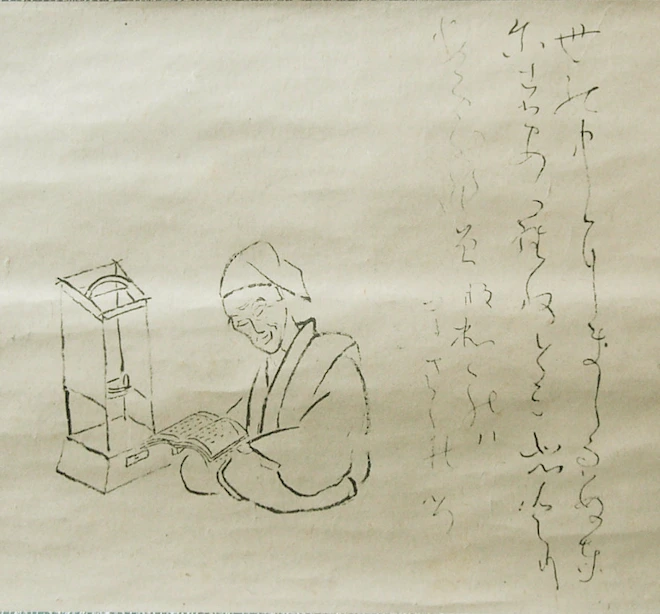
Over the years I have wept reading certain poems. One poet I keep returning to is the Japanese monk Ryōkan Taigu, who lived from 1758 to 1831.
Ryokan was a hermit monk who left behind poetry and calligraphy instead of doctrine.
He was a quiet and eccentric Sōtō Zen monk who spent much of his life alone in the mountains. What remains of him is his brushwork and his verse, and in both you can feel the plain texture of a life lived without pretense. Here he is, musing on what poetry actually is:
Who says my poems are poems? My poems are not poems. When you know that my poems are not poems, then we can speak of poetry!
The most famous story about him concerns a thief who came away with nothing but the moon.
It is recounted in Great Fool: Zen Master Ryōkan: Poems, Letters, and Other Writings. One night a man broke into Ryokan’s hut to steal something. Ryokan owned exactly one blanket, which he used to cover himself day and night. It was his only possession.
Finding nothing else in the hut, the thief prepared to leave empty-handed. Ryokan felt sorry for him.
If the poor fellow had informed me before, I could have begged something from the neighbors and kept it here for him to steal. But now what can I do?
He gave the thief his blanket. When the man was gone, Ryokan sat naked in his hut and wrote:
The thief left it behind — the moon at the window.
That single line says more about the bodhisattva path than most commentaries manage in a chapter.
It does not resolve neatly. It is not meant to. Ryokan is not offering an argument, he is trying to shake us loose from the ordinary way we hold on to things, so that we might act, plainly and without calculation, on behalf of what the old texts call mother sentient beings.
John Keats made a similar point about how poems ask to be read.
Keats died at twenty-five, leaving fifty-four poems behind. In a letter to Fanny Brawne he wrote:
A poem needs understanding through the senses. The point of diving in a lake is not immediately to swim to the shore; it’s to be in the lake, to luxuriate in the sensation of water. You do not work the lake out. It is an experience beyond thought. Poetry soothes and emboldens the soul to accept mystery.
This is close to what our practice asks of us.
We are not here to interpret the present moment or manage it. We are here to sit in it, the way Ryokan sat in his empty hut, and let its mystery be enough.
A thief left with nothing, and a monk sat by his window, wishing he had more to give.
Comments
2 responses to “I wish I could have given him the moon”
Thanks for writing : )
So happy you left a comment Etienne, and sorry I just now am seeing this. Warm wishes to you, be well and safe!