I read a story the other day, attributed to Nikolai Gogol, about a horse stuck in the mud. It struggled and struggled to free its hooves. When it finally did, a fly flew up from the horse’s tail to its head and said:
We did it!
I smiled. Yes, sounds like something I would say!
I spend a lot of my day planting the flag of me.
A few weeks ago I decided to notice how often I do this, how often I try to claim some small piece of psychological or physical territory as mine. I gave up after a few hours.
I lost count, and along with it, some of my self-esteem.
The meditation teacher Larry Rosenberg once described a cartoon he had seen: a Zen monk walking along a beach, carrying an enormous bag over his shoulders, so heavy that his footsteps left craters in the sand.
On the bag was written one word — ME.
Meditation is where I set that bag down. It makes my path through this life a little lighter. I pick the bag back up again soon enough, but I have come to accept even a little temporary relief from carrying it.
I ask myself sometimes what keeps my practice alive.
Where is my edge of learning?
One answer is noticing how my body feels when I am being inauthentic. Is there a contraction somewhere, a tightness, a numbness? I drop whatever story I am caught in and do a free-form scan of the body instead.
I think of the monk on the beach with his heavy bag, and I feel my own feet as I walk. Am I leaving craters?
Each time I check, I feel a small shiver of relief.
It is tempting to keep trying to become someone I am not, some future version of myself I imagine meditation is building toward, a Tom 2.0. But there is another way to live this ordinary life, in peace, just as it already is.
For that, I need to put the bag down and catch my breath. Mary Oliver’s poem “Yellow” says it better than I can:
There is a heaven we enter
through institutional grace
and there are the yellow finches bathing and singing
in the lowly puddle.
Can you sit for a moment with what it means to be here, now, without pretense, free and at peace, “bathing and singing in the lowly puddle” of your own ordinary life?
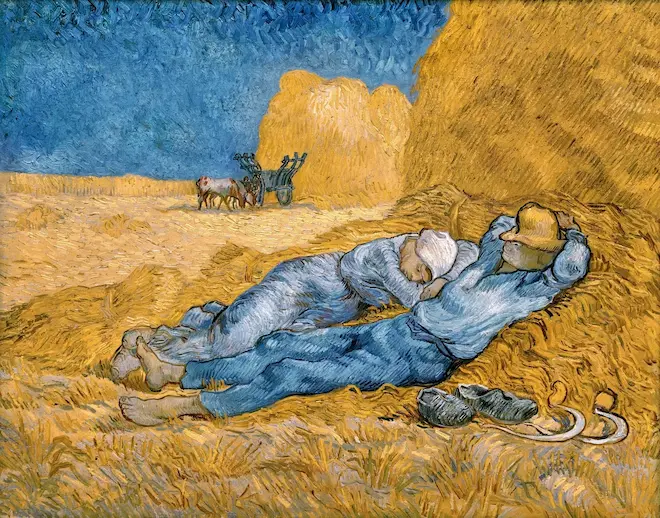
Some moments in meditation are simply sitting and breathing.
There are times in breath practice when it feels less like breathing and more like being breathed. No reaching for a special state, just the body sitting.
A maturing practice, I have come to think, is a more relaxed one. Nothing more than the innocence of a body sitting quietly.
Meditation can turn into a kind of extreme sport, complete with training programs for those chasing the elite ranks. What if we set that fantasy aside for a while, and simply relaxed instead?
A slow, simple life is all I really want.
The writer Krista O’Reilly Davi-Digui, who writes about minimalism, once put it this way:
What if I embrace my limitations and stop railing against them? Make peace with who I am and what I need and honor your right to do the same. Accept that all I want is a small, slow, simple life.
That is all I want too — a small, slow, simple life.
Carl Jung described a different way of understanding the spiritual path. Rather than climbing a steep mountain toward perfection, he said, we “unfold into wholeness,” the wholeness already present, right here, right now.
We are not trying to vaporize our bad karma or slay our demons. That is a difficult job to do well, and our best efforts at it often leave us with new problems instead.
We only need to settle into the small, slow, simple life already here.
That means embracing this moment, messy and incomplete as it is, without trying to improve or tweak it. Trying to tweak things only brings more frustration. The present moment, as I have written elsewhere, cannot be tweaked.
There is a quiet joy that has always been present, buried under layers of reactivity and compulsion that quietly run our lives.
The path is simple. Thich Nhat Hanh, now gone, left us these instructions:
Smile, breathe, and go slowly.
Smile. Breathe. Go slowly.
That is the whole practice.