The lychees did not fruit much this year. In fact, barely at all. I thought maybe it was something I said. Some freaky karma thing.
Two years ago, our family was excited to see the tiny new buds of incredibly young lychees, like a slow-breaking wave of green on the venerable tree in our backyard.
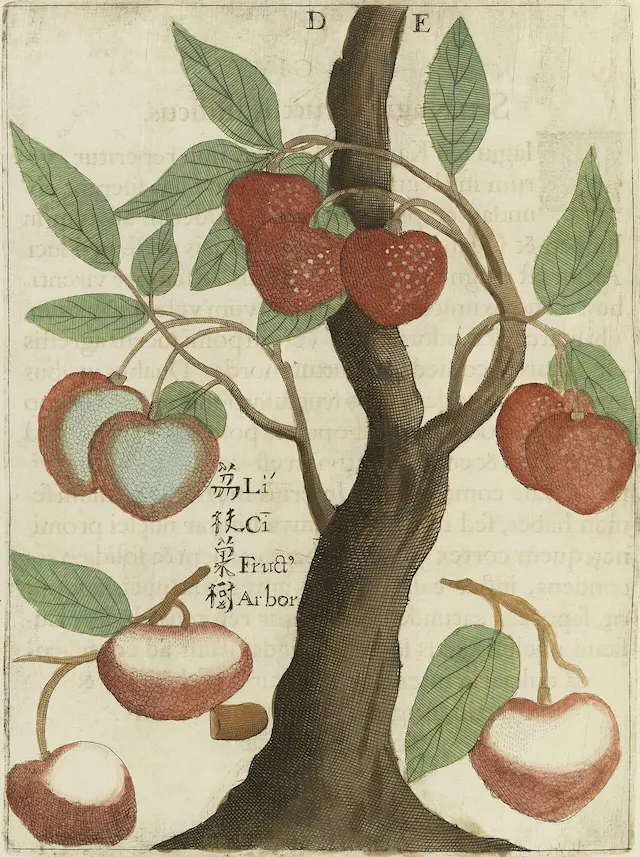
Of course, not all of the tiny, incredibly young buds would make it to full lychee-dom. But I had not expected so many not to make it. I remember getting out the rake and gathering all the incredibly young casualties of nature.
In time, we would see the first tinges of red in the young lychees, like an adolescent blushing at an awkward remark, spreading through the branches and scraggly canopies of leaves in the old tree.
Anticipation leads to expectation, which leads to grasping
We would hear remarks from the folks who come to meditate on Thursdays at our home—”any day now”—as they glanced at the tree in the last rays of the Manoa evening sky, some relishing the sight in their post-meditative glow.
Then came the days when our family would pick so many lychees we could not possibly eat them all, even after giving some away and having the Thursday meditation crowd savor them, post-meditatively.
So we peeled and froze them for the smoothies and ice cream toppings of the future.
All the while I kept raking up the ones that did not make it, landing on the ground under the tree after being half eaten by birds, or wrenched from their homes by the occasional gusts of Manoa Valley wind, breaking open when they reached the ground, their white flesh exposed like glistening bandages under their red, spiny skins.
But that was then. Now, it is hardly worth raking lychees—there are so few. A sorrow came over me as I processed this letting go, and all the memories and anticipation around the lychees.
Impermanence again
I think about impermanence, and all the different projects I have going—many will not last past the conceptual stage. More letting go.
I ask myself what it feels like, letting go of the lychees. And what it feels like, letting go of everything that is not arising and passing in the present moment.
Can I drop thinking about my life over and over, and all that is left undone, like so many unborn lychees?
Can we let go of concepts?
We tend to take a simple moment of experience—a sensory experience, a thought, or a feeling—and spin a web of concepts around it.
It is not that simple to observe a thought without getting involved in its orbit. We tend to follow, resist, or judge our thoughts.
Before you know it, what began as the thought “Where are the lychees this year?” becomes a swirling mass of intertwining concepts and ideas, along with eddies and tide pools of emotion and reactivity.
The same pull happens with the practice itself. We compare and contrast meditation methods, resist doing it, and, of course, judge our practice against some perceived ideal.
Letting go of anything that tries to pull you away.
The work of meditation is finding a home in the present moment, and letting go of anything that tries to pull you away—intentions, schemes, expectations, projects, and grasping.
Lisa Dale Miller, Ph.D., in a recent talk, commented:
When we practice letting go again and again, a spacious quality of mind that is naturally open and free emerges from the background of our consciousness into the foreground of our experience. If we can stay with the freshness of what is unfolding, aspects of our being conditioned by grasping and reactivity are gradually able to release.
I stay with the freshness of now, even while so much else waits unborn, like this year’s lychees.