After decades of practice, I’ve come to one firm conclusion: mettā is the bee’s knees. Possibly the elephant’s knees. You see, the story goes that the Buddha once stopped a charging elephant with mettā — or unconditional goodwill — which suggests it may be more powerful than we give it credit for.
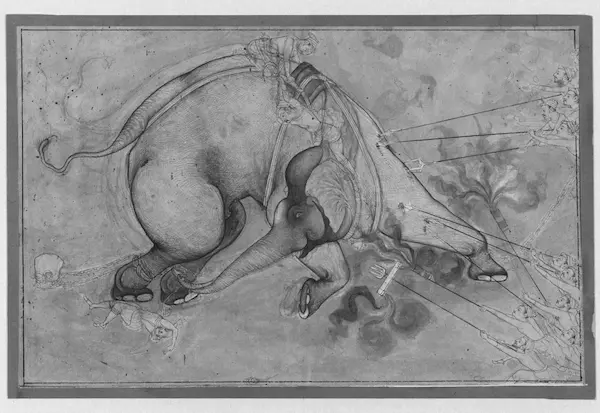
A word on backstory: his cousin Devadatta had been jealous of the Buddha’s fame for years. His solution was to arrange for a massive, enraged elephant to be released directly into the Buddha’s path during his morning alms round.
Run and lose face, or get trampled. Either way, Devadatta wins.
The Buddha just stands there, in the middle of the road, with this enormous animal bearing down on him, and he does something that sounds almost absurd: he grows still and meets the elephant with mettā — not a technique, just a quality of heart, steady and open.
In the story, the elephant slows, then stops, and finally kneels.
You don’t have to take that literally. What the story points to is this: a mind genuinely settled in mettā — unconditional goodwill — has a quality that changes whatever comes into contact with it.
Even, apparently, a charging elephant.
We know this from our own lives. We have walked into a room where someone was genuinely at ease and felt something in us loosen. We have also walked into a room where someone was radiating hostility and felt our shoulders rise before a single word was spoken. No elephant required.
These days it does not take much effort to find our own charging elephants.
A glance at the news and there it is, something large and threatening coming straight at the more tender parts of the heart.
The body tightens, the breath gets shallow, and the mind starts rehearsing arguments and fears, as if the only options were to fight, to flee, or to shut down.
I first encountered this elephant story — and yes, the Pali Canon is not short on elephants — in a talk by Joseph Goldstein, where he asks a deceptively simple question:
Does mettā only affect our own mind, or does it somehow move outward as well?
His answer: a mind suffused with mettā is not just a private experience — it touches the world in ways we may not see.
He suggests the next time you are standing in line, or sitting in traffic, or waiting with nothing much happening, you might quietly wish the people around you well. Nothing elaborate, just a soft inner murmur:
May you be happy; may things go all right for you today.
Often what changes first is not the other person at all but the atmosphere inside your own chest. You feel a bit more present, a bit more connected, and the people near you begin to look less like inconveniences and more like fellow travelers.
What happens if, instead of going small, you try a little of what the Buddha tried on that road — with that elephant — on that ordinary morning?
Leave a Reply