… when the mind complains it does not want to meditate, says the Buddhist monk U Tejaniya.
I am going to assume you are like most of us who take up meditation — you struggle to maintain a regular practice. You may even wonder when the best time to meditate really is.
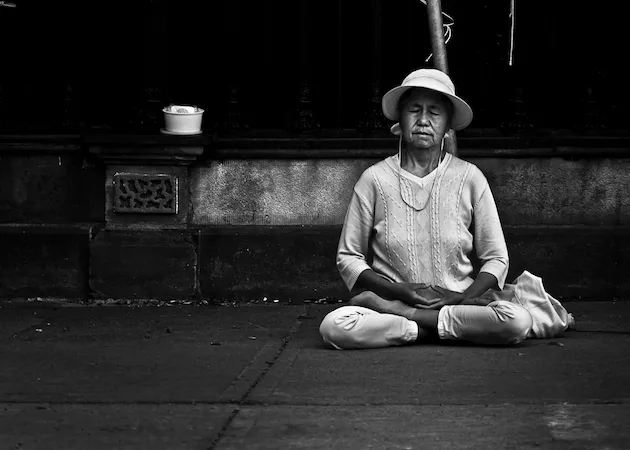
The instructions are simple enough: be aware of what is happening in the present moment. And yet, right away, we find this challenging and humbling.
We see that the mind has a mind of its own, and it does not easily settle down.
Even for people I know who have been meditating for forty years, daily practice is not always a cakewalk.
When I was in graduate school, we learned that the main work in therapy is working with resistance. I believe it was Irving Yalom who observed that therapists meet clients where they are, and take them where they do not want to go.
This is what Sayadaw U Tejaniya was saying in the opening line above. The best time to meditate is when our resistance is front and center. When we follow his advice, we chip away at the basic resistance we all carry as human beings.
One of the first letdowns is that meditation is not what we thought it would be.
We are not trying to have an out-of-body experience, one teacher once said. We are trying to have an in-the-body experience, with how we are, just as we are, in the present moment.
I remember reading a conversation between Jack Kornfield and Pema Chödrön some years ago. They were discussing what makes the Buddhist approach to meditation remarkable, and Pema Chödrön put it this way:
The Buddhist teachings are fabulous at simply working with what’s happening as your path of awakening, rather than treating your life experiences as some kind of deviation from what is supposed to be happening.
When I read that, I simply sighed. What a relief.
It is good to create space, get settled, and enjoy a little bliss now and then.
But it is during the moments that test our resolve that we see where we are stuck, and what we still need to let go of.
And what we work on in meditation carries out into the rest of our life.
That is the magic of meditation.
Mindfulness is about getting down to the nitty gritty of our lives, exposing our vulnerability, and being with whatever comes our way, as Sayadaw U Tejaniya says:
Looking for something which we think we are supposed to see is not mindfulness meditation. Mindfulness meditation is just being aware of whatever comes your way.
The nitty gritty of our lives is just this cup of coffee that is too hot, this car that needs new tires and may not make it to work today, or these construction workers invading a quiet morning.
Life is not supposed to go any particular way. Neither is our meditation.
We simply show up for what is. Pema Chödrön explains:
We get misled by the ads in magazines where people are looking blissful in their matching outfits, which also match their meditation cushions. We can get to thinking that meditation is about transcending the difficulties of your life and finding this just-swell place. But that doesn’t help you very much, because that sets you up for being constantly disappointed with what happens every day at breakfast, lunch, and dinner — all day long.
A frequent complaint I hear from students is that they can never find the right time to meditate.
If you are alive, now would be a very good time.
Let us give Sayadaw U Tejaniya of Burma the last word:
Don’t assume conditions are bad for practice. There is a lot you can learn from what you think are unfavorable conditions for meditation. There may be unhappiness or suffering. Don’t make judgments that these conditions are bad for practice.
In Dhamma, there is only what’s happening. Accept the situation and be aware.